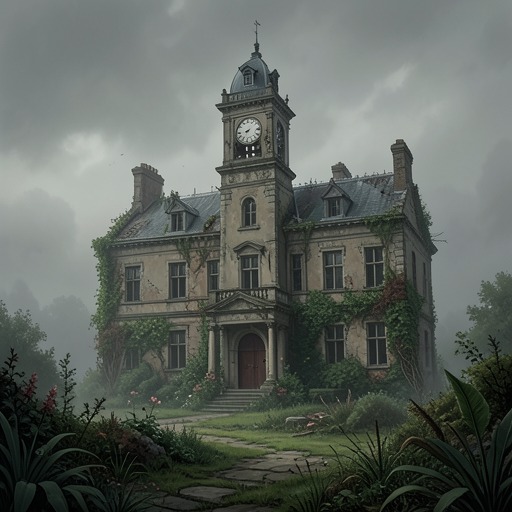
Bluff Court's decline
The Darling Buds of MayBluff Court's decline is the predicament of an inherited country estate too costly to sustain and too deeply bound to its owner's sense of continuity to relinquish. Its sixty rooms, extensive outbuildings and grounds make its grandeur a burden; yet Sir George Bluff-Gore initially treats selling it as unthinkable. The house's eventual fate is set against Lady Rose Bluff-Gore's private hope that demolition might free the family from debt and make a different life possible.
Scale and the burden of upkeep
Bluff Court is far too large for its owners to live in comfortably. The house contains sixty rooms, while its surrounding estate includes a hamlet's worth of barns, dairies and stables, half a mile of greenhouses and potting sheds, and an orangery in which no oranges have grown for fifty years. Heating the house takes a hundred tons of coal each winter; keeping the grounds tidy and productive in summer would require eighteen gardeners. The household would also need twenty servants, with another twenty to serve them. Even so, servants are difficult to find, and the estate could scarcely afford their wages.
These particulars make decline a matter of daily economics as well as appearance. The estate's scale, once a mark of rank, has become an obligation that its owners cannot meet. The empty orangery and impractical staffing requirements expose the distance between the house's inherited grandeur and the resources needed to keep it functioning.
Sir George's resistance to selling
When Pop Larkin abruptly asks when Sir George will sell Bluff Court, Sir George is taken aback. He has no intention of parting with it, despite its size and the financial pressure it represents. To him, selling is not merely a practical decision but an intolerable break with the estate's place in the landscape: among its neglected beeches, elms and oaks, Bluff Court must remain standing.
His thoughts turn toward a possible alternative: renting the property to a wealthy stockbroker who might play at farming, absorb large losses and ultimately benefit through the tax system. Sir George regards this as a sign of the country's grim condition, not as a satisfying solution. Pop, by contrast, answers the sentimental attachment with blunt practicality, pointing out that Sir George does not live in the house and, in Pop's judgment, never will. Sir George's response makes clear that Pop has not been invited to decide the estate's future.
Lady Rose's private alternative
Lady Rose considers Pop's proposal differently. She has long wanted to pull Bluff Court down herself, along with its miles of greenhouses, unused stables and draughty barns. The suggestion gives shape to a wish she has already entertained: perhaps demolition could leave the family with money in the bank instead of living on overdrafts. It might even make it possible for Rosemary to return, or for the household to live in comfort for a change.
Her hope does not erase the cost of relinquishing the house; it reveals that its preservation has become a source of strain rather than security. After asking Pop what he thinks the property is worth, she hears that he can inspect it the next day and tell her. The possibility of sale thus emerges not from Sir George's willingness to abandon the estate, but from Lady Rose's awareness that continuing as before has its own price.
Demolition and the changing order
The later fate of Gore Court gives this decline a concrete parallel. Pop recalls that Sir George Bluff-Gore, hampered by taxes and unable to maintain the ancestral house, sold it to Pop for demolition and went to live in a stable. The recollection places the collapse of an aristocratic household beside Pop's own rise as a buyer able to acquire and remove the old property. The traditional estate persists neither unchanged nor simply as a ruin: it can be sold, dismantled and converted into something its former owner cannot afford to keep.
The contrast also sharpens the tension at Bluff Court. Sir George's first refusal and Lady Rose's private wish for demolition express different responses to the same failing system of upkeep. The house's decline is therefore not only architectural. It records the erosion of inherited status under financial pressure, while the prospect of its destruction offers the owners both loss and a chance—however uncertain—of relief.